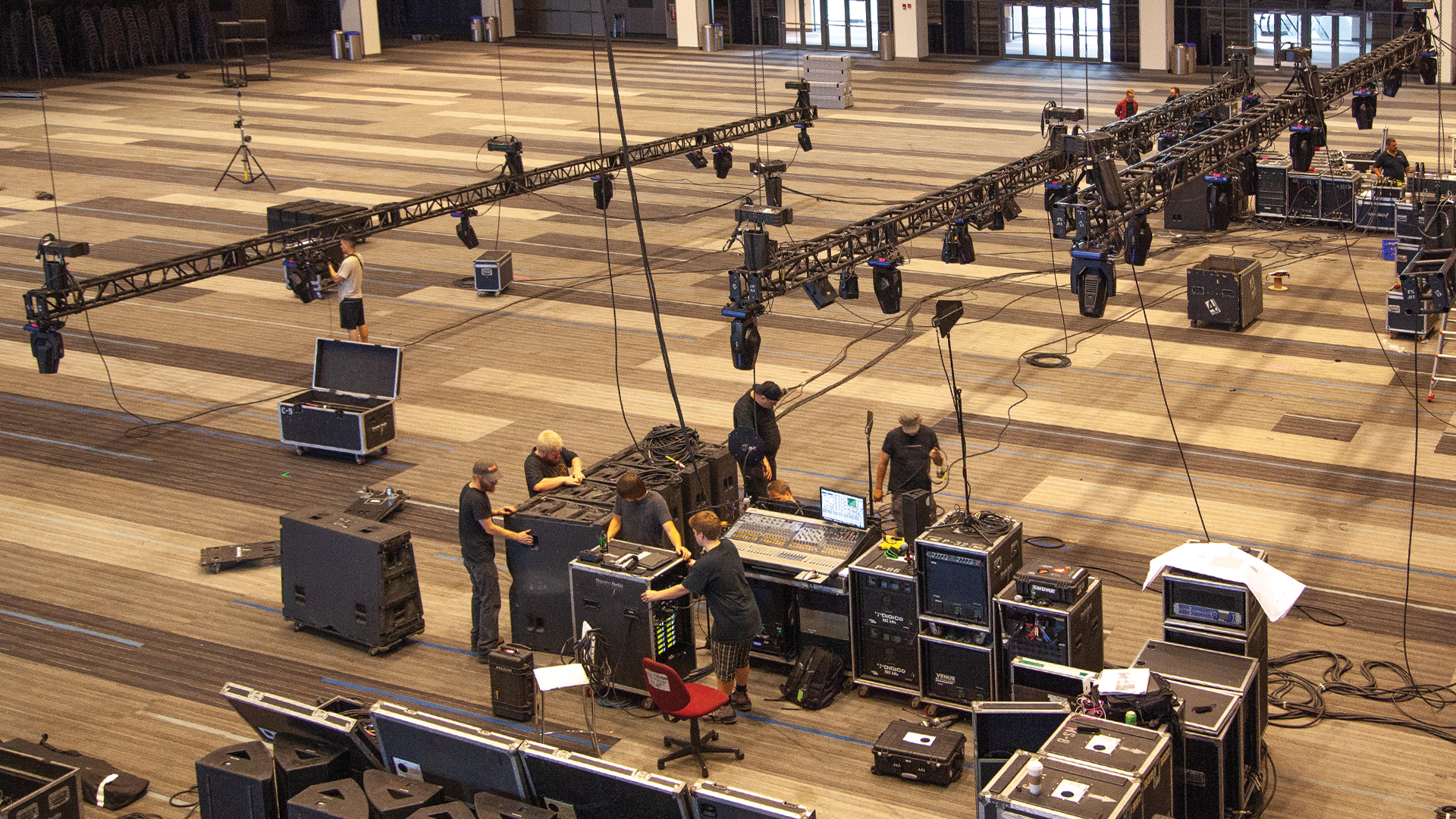
The show truck is not a storage container. It is a precision instrument — a three-dimensional puzzle whose solution determines whether your crew hits load-in time with five minutes to spare or spends the first two hours on site playing Tetris with road cases in a parking garage. Packing strategy is where production management meets logistics engineering, and the companies that consistently deliver tight, on-time load-ins are the ones that have developed systematic truck loading protocols built on years of refined practice.
The Origins of Road Case Culture
The road case as we know it — aluminum-edged, recessed hardware, foam-lined — evolved primarily from the British touring industry in the late 1960s and early 1970s. Companies like Anvil Cases in the UK and, later, Calzone and TF Cases in the US standardized the external dimensions of equipment protection around common truck floor widths and standard pallet sizes. This standardization was intentional: it made stack planning calculable.
The emergence of modular trussing systems in the late 1970s — pioneered by Tomcat and Total Structures — added a new category of long, heavy, oddly-dimensioned cargo that truck loaders had to integrate with sensitive electronics and audio equipment. This tension between structural steel and delicate gear has shaped truck loading strategy ever since.
The Fundamental Rule: Load in Reverse Show Order
The most fundamental principle of efficient truck packing is reverse chronological loading: the last item loaded should be the first item needed on site. This sounds obvious, but executing it correctly requires a detailed understanding of the load-in sequence, which in turn requires communication between the truck packing team and the department heads who will be running the load-in.
The standard sequence on a concert or theatrical tour load-in runs roughly: rigging hardware first, then trussing and motors, then lighting fixtures, then video, then audio infrastructure, and finally staging and soft goods. This means in the truck, staging elements go in first (deepest), and rigging hardware goes in last (nearest the door).
Zoning the Truck
Professional touring companies divide the truck into load zones — physical sections of the trailer assigned to specific departments or load-in phases. A typical 53-foot semi-trailer might be divided into five zones from nose to tail: production office and expendables in the very nose, audio front-of-house and system racks next, lighting and video infrastructure in the middle sections, trussing bundles behind that, and rigging and motors right at the tail gate.
Zone planning is documented in truck pack drawings — dimensioned floor plans and elevation sketches showing exactly where each case or bundle goes. Some production companies use CAD software like AutoCAD or production-specific tools like Vectorworks Spotlight to create truck pack drawings as part of pre-production. Others maintain hand-drawn or spreadsheet-based load plans refined over multiple tour legs.
Weight Distribution and Road Safety
Beyond load-out efficiency, truck packing has a legal and safety dimension: axle weight distribution. DOT regulations cap steer axle weight at 12,000 lbs, drive axle tandem weight at 34,000 lbs, and trailer axle tandem weight at 34,000 lbs, for a standard maximum gross of 80,000 lbs. Packing heavy audio amplifier racks and motor control systems entirely in the nose of the trailer can push the steer axle over legal limits, resulting in fines, scale delays, or worse — compromised steering dynamics.
Experienced truck loaders distribute weight approximately 60/40 front-to-rear in the loaded trailer, keeping the heaviest items between the landing gear and the drive axles. This distribution typically satisfies DOT requirements and provides stable handling characteristics for the driver.
The Art of Vertical Stacking
Vertical space utilization is where significant efficiency gains are found in show truck packing. Standard 53-foot trailers have interior heights of 108–110 inches, enough for road cases stacked three high in many categories. The rule is always heaviest on the bottom, lightest on top, with lateral bracing wherever stacks exceed two cases high.
Smart case design aids stacking: stacking tabs on road case lids — male/female recessed tabs that interlock cases in a stack — prevent lateral shifting during transit without requiring additional lashing. Roto-molded cases from Pelican and SKB generally do not have stacking tabs and require more careful arrangement.
Labeling, Documentation, and Digital Tools
Every case in a professional touring truck should carry a case label that specifies: department, contents description, show position (where it goes on site), and load zone. Color-coded labels by department — red for audio, blue for lighting, yellow for video, green for production — allow crew members to self-direct during unloading without supervisor guidance on every case.
Digital truck pack tools are gaining traction in production. Flex Rental Solutions and Current RMS — both widely used rental inventory management platforms — include truck pack modules that can generate load plans from the asset list. Some touring companies are experimenting with QR code scanning systems where each case is scanned onto the truck and scanned off, creating a digital manifest that also verifies load zone compliance.
Building the Pack for a Specific Venue
The key insight experienced production managers hold is that truck packs are venue-specific, not universal. A truck packed for a loading dock with a hydraulic leveler requires a different sequencing than one loading into a ballroom via a ramp. The production advance process — gathering venue-specific information weeks before the event — should always include a detailed understanding of the load-in path: dock height, elevator dimensions, corridor widths, and distance from truck to stage. Pack the truck to match the reality of where it’s going, not a generic ideal.
