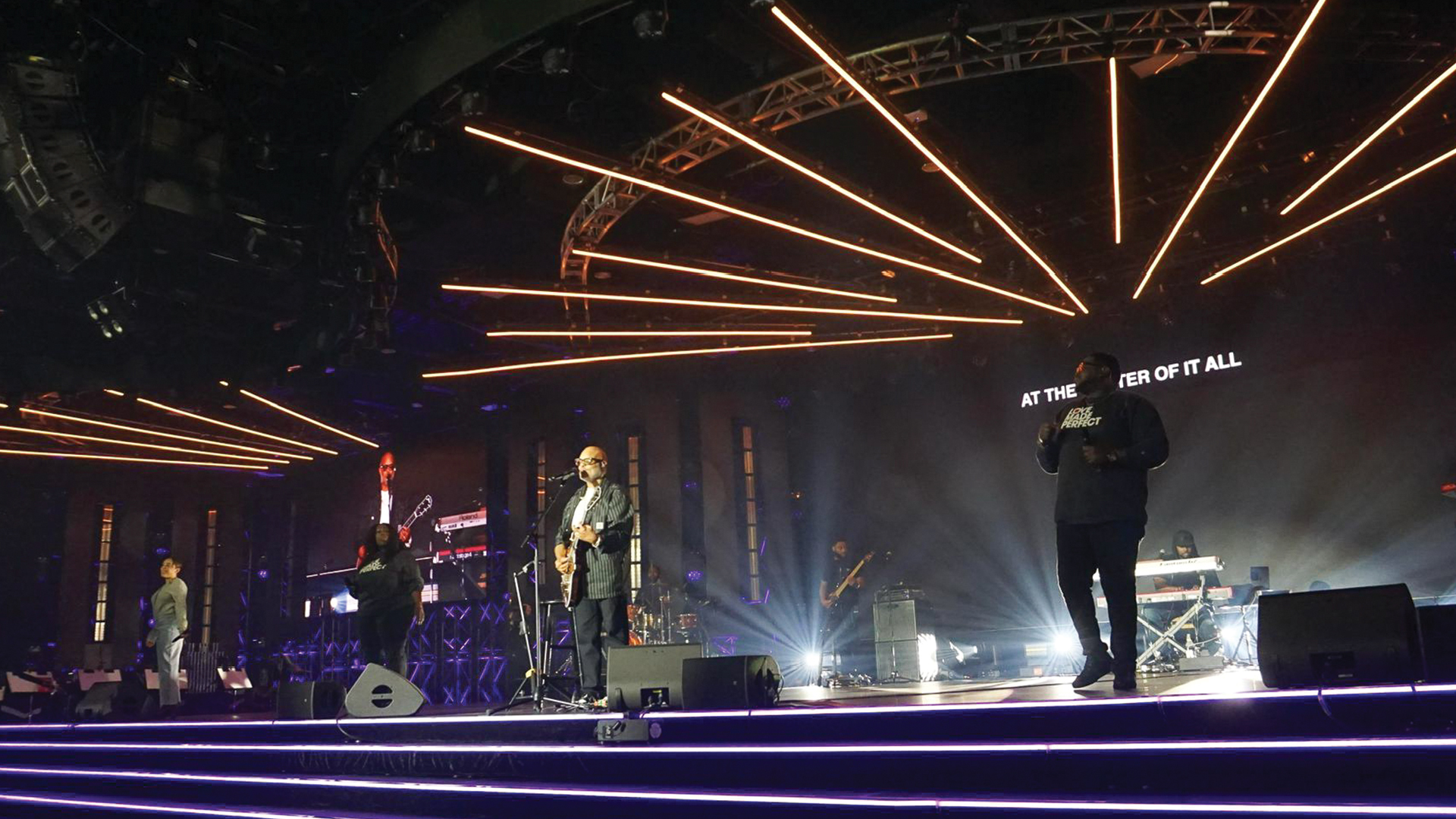
The RFP arrives for an event that will host 500 people if the registration response is modest, or 2,000 if the marketing push hits. The client needs a scalable production — one that works beautifully at the small end of the range without wasted expense, and expands naturally to the large end without looking like it was designed for something else. Building shows that scale is a discipline unto itself: it requires modular system design, flexible infrastructure thinking, and a production architecture that treats scaling as a feature rather than an afterthought.
The Business Case for Scalable Production Design
Scalability in production design has both a client-service dimension and a business efficiency dimension. From the client’s perspective, a production partner who can offer genuine scalability — the same design language at multiple scales with corresponding pricing — offers more value than one who can only deliver a fixed configuration. From the production company’s perspective, a modular inventory system that can be deployed in configurations from 10% to 100% of maximum capacity earns higher utilization rates across more events than specialized systems built for single configurations.
Companies like PRG (Production Resource Group) and VER (Video Equipment Rentals) — two of the largest touring and event AV rental companies — built significant competitive advantage through modular system design that allows rapid reconfiguration across event sizes. Their investment in standardized modular trussing systems, scalable audio line array configurations, and flexible LED tile inventory paid dividends in the ability to serve events at wildly different scales with the same underlying infrastructure.
Audio: Line Array Scaling
Modern line array speaker systems are inherently scalable in a way that the point-source speaker designs they replaced were not. A d&b audiotechnik V-Series array, for example, can be deployed as four elements per side for a 300-person conference room or as twenty elements per side for an outdoor festival — the same boxes, the same rigging hardware, the same amplification platform, reconfigured in quantity. The d&b ArrayCalc simulation software models both configurations and specifies the amplification requirements, allowing a production company to carry a single line array system that serves multiple event scales.
The scaling decision in audio is not just about box count — it’s about amplifier capacity, processing architecture, and system drive. A Lake LM 26 processor can serve a four-box array or an eight-box array with only configuration changes. An Outline Newton system allows full DSP reconfiguration on the fly. Designing audio systems around these flexible processing platforms means the electrical infrastructure scales with the box count rather than requiring different processor units at different scales.
Lighting: Modular Rig Design
Scalable lighting design starts with identifying the core design elements that must be present at all scales — the non-negotiables — and the enhancement elements that add value at larger scales but are not required at smaller ones. A corporate general session rig, for example, might have a non-negotiable core of: stage wash, presenter specials, and screen illumination. Enhancement elements at larger scales might add: audience illumination, pixel mapping elements, moving light effects, and perimeter effects.
Designing the core rig as a self-contained, cable-correct system that installs completely independently of the enhancement elements means that the crew can load in the core at the small-scale event and add enhancement elements at the large-scale event without rewiring the core. This requires planning cable infrastructure to accommodate future expansion — pre-running longer cable runs than the current rig requires, installing extra data ports in the rig, and leaving headroom in the dimmer patch for additional fixtures.
Video: Tile-Based Scaling
LED tile systems are among the most naturally scalable technologies in production. A 3.9mm LED tile inventory — 100 square meters of Absen Acclaim series or ROE Visual CB3.9 — can build a 5×3 meter backdrop for a small event or a 20×5 meter background for a large one, using the same tiles, the same power and data distribution, and the same NovaStar MCTRL4K processing platform scaled up in processor count. The physical inventory is identical; only the configuration changes.
Scalable video systems also require flexible content design. Content created for a 16:9 aspect ratio backdrop will not fill a 4:1 ultra-wide format correctly without either distortion or letterboxing. Designers serving scalable productions should create modular content assets — abstract backgrounds, logo treatments, and motion graphics — in formats that can be cropped, tiled, or extended across different aspect ratios. Adobe After Effects and Resolume‘s content management tools support non-destructive format adaptation.
Network and Signal Infrastructure
The infrastructure that is most expensive to change on site — cable runs, network architecture, signal routing — should be designed at maximum scale from the start. Running fiber backbone capable of carrying 48 channels of audio and 4K video signals for a small event costs only marginally more than running a backbone sized for that event’s actual requirements, and eliminates the need to re-pull infrastructure when the event scales up.
Standard infrastructure choices for scalable show design include: Dante audio networking (inherently scalable from 2 to 512 channels without changing physical infrastructure), 12G-SDI video routing (handles 4K single-link, future-proofing video infrastructure), and CAT6A data infrastructure rated for both current and future network requirements. These choices cost a modest premium over minimum-spec infrastructure but pay for themselves on the first event that needs to scale beyond the original design.
Documentation for Scalable Systems
Scalable shows require multi-version documentation: separate system diagrams for small-scale, medium-scale, and large-scale configurations, each showing the complete signal flow, patching, and component list for that configuration. Without this documentation, scaling becomes ad-hoc — adding equipment in the moment without a pre-planned integration that has been checked for conflicts. The production crew then discovers problems in the field rather than in pre-production, costing time and potentially quality at the event where the most is at stake.
