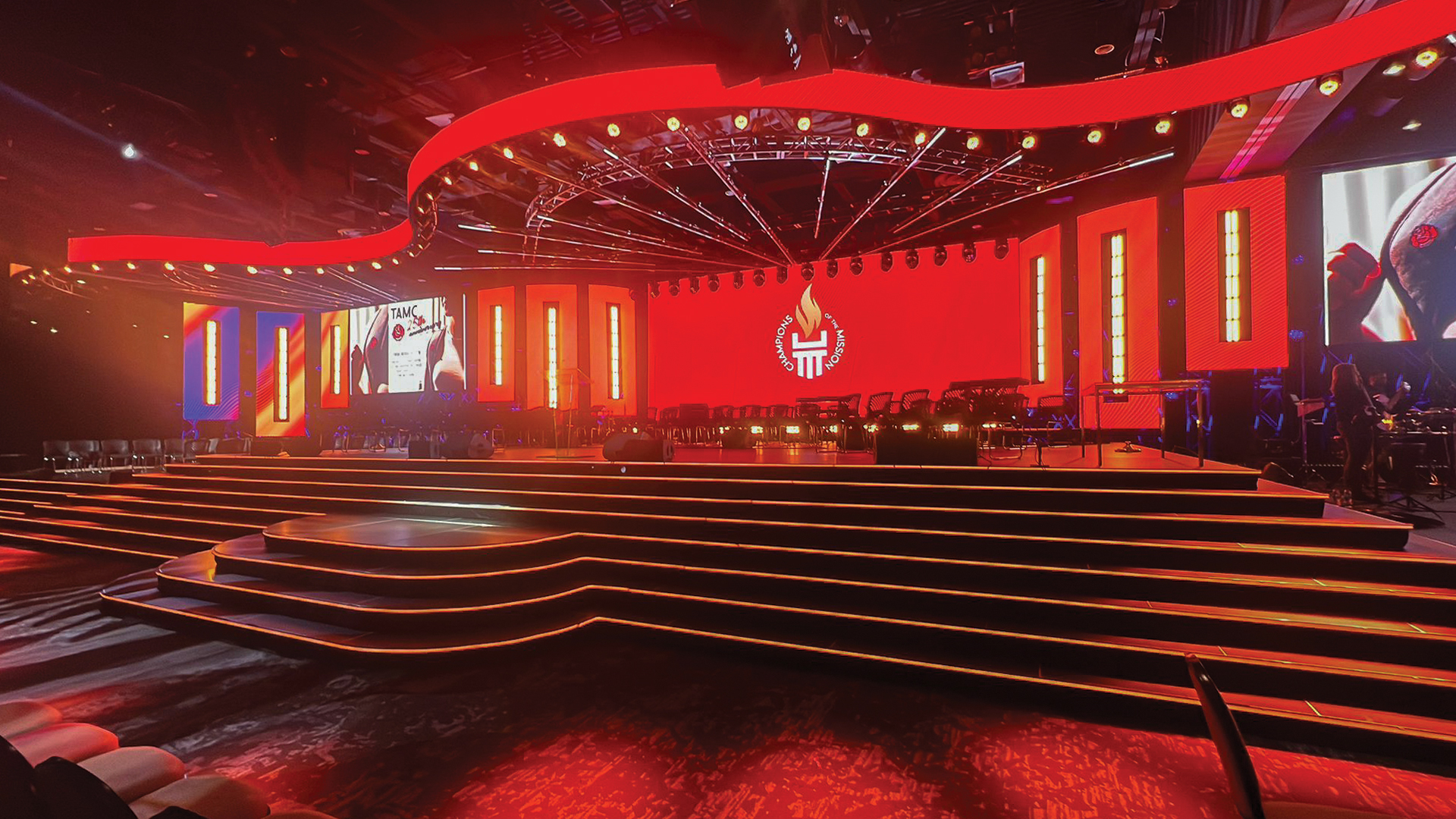
When Rectangles Simply Won’t Do
The rectangular LED video wall has dominated event production for two decades, but something remarkable happens when designers break free from the four-corner paradigm. Scenic LED shapes—curves, spheres, triangles, and custom geometries—transform productions from professional to unforgettable. The construction journey from concept to execution involves engineering challenges that separate master craftspeople from amateur assemblers.
The origin story of shaped LED surfaces traces to the touring industry, where productions like U2’s 360° Tour pioneered cylindrical and spherical display configurations. PRG and Tait Towers collaborated to create LED surfaces that wrapped around performers, establishing fabrication techniques that eventually filtered into corporate and broadcast production.
Walking the exhibit halls at LDI or InfoComm reveals the current state of shaped LED artistry. Manufacturers including ROE Visual, INFiLED, and SiliconCore now produce panels specifically engineered for curved and angled configurations, with integrated locking mechanisms that maintain precise alignment across non-planar surfaces.
Engineering the Support Structure
Every large scenic LED shape begins with structural engineering that calculates loads, stress points, and assembly sequences. The complexity multiplies exponentially compared to flat wall construction because each panel occupies a unique position in three-dimensional space with distinct mounting angles and weight vectors.
The structural steel or aluminum framework underlying shaped LED installations typically requires custom fabrication. Companies like ATOMIC Design and Scenery West employ CNC plasma cutters and robotic welders to produce precision frames that match CAD specifications within millimeters. These frameworks often incorporate unistrut channels for adjustable panel mounting positions.
For curved surfaces, the relationship between panel size and curve radius determines feasibility. A gentle 50-foot radius curve accommodates standard 500mm panels without modification, while tighter 10-foot radius curves demand either smaller panels or custom-curved modules from manufacturers willing to tool specialty products.
The Panel Selection Matrix
Selecting LED panels for shaped installations requires evaluating specifications beyond typical wall deployments. Viewing angle becomes critical when panels orient away from primary audience positions; panels with 160° viewing characteristics that perform adequately in flat configurations may fail dramatically when angled 45° off-axis in shaped applications.
The mechanical design of chosen panels determines assembly possibilities. Products from Unilumin and Leyard feature corner-locking systems that create rigid connections suitable for cantilevered shaped sections. Other manufacturers design primarily for flat stacking, requiring supplementary mounting hardware for shaped deployments.
Pixel pitch selection for shaped installations often differs from flat wall specifications. Because shaped surfaces place portions of the display closer to audiences, the effective viewing distance changes across the surface. A design that calculates minimum viewing distance for the closest display section—rather than average distance—avoids visible pixelation at critical positions.
Cabling Architecture for Complex Geometries
The signal distribution and power delivery for shaped LED installations present puzzles that flat wall deployments never encounter. Cable runs must navigate three-dimensional pathways while maintaining signal integrity and meeting fire code requirements. The National Electrical Code articles governing temporary installations provide the regulatory framework, while practical experience fills in the details.
Data distribution using SMPTE ST 2110 or proprietary protocols requires careful planning of fiber optic runs that accommodate the irregular geometry. Each panel in a shaped configuration may receive signal from a different direction than its neighbors, requiring cable management systems that prevent tangling during assembly and strike.
Power calculations for shaped installations must account for inconsistent cable lengths creating voltage drop variations. A panel positioned at the far end of a curved surface might receive power through a 150-foot cable run, while its neighbor connects through 50 feet. PowerCON TRUE1 connections and properly sized conductors ensure consistent performance across the entire shape.
Content Creation for Non-Rectangular Surfaces
The creative potential of shaped LED surfaces only manifests when content specifically designed for the geometry plays across those pixels. Standard 16:9 content displayed on curved or angled surfaces creates visual artifacts and wasted pixel real estate. Content producers must create custom aspect ratios and sometimes custom perspective corrections for each unique shape.
Disguise (formerly d3 Technologies) and Green Hippo Hippotizer media servers have led the industry in providing tools for mapping content to irregular shapes. Their projection mapping algorithms, originally developed for projector-based installations, adapt elegantly to shaped LED configurations where pixel positions correlate to three-dimensional surface coordinates.
The content pipeline for shaped installations typically involves Cinema 4D or Blender for 3D visualization, After Effects for motion graphics creation, and media server software for final output mapping. Artists working on projects for clients like Cirque du Soleil or major music tours develop specialized workflows that optimize this complex production chain.
Assembly Sequencing and Rigging Coordination
The assembly sequence for shaped LED installations follows logic completely different from flat wall deployments. Rather than simple bottom-to-top or left-to-right progressions, shaped builds often require starting from structural anchor points and radiating outward, or assembling sections on the ground before hoisting into position.
Rigging coordination with CM Lodestar or JR Clancy systems demands clear communication between video technicians and riggers. When a spherical LED segment lifts from the deck, both teams must understand the rotation orientation, final trim height, and connection sequence. The ETCP-certified riggers who staff major productions bring essential safety knowledge to these complex lifts.
Pre-assembly strategies reduce on-site complexity for touring productions. A shaped LED element might arrive at venues with 70% of panels already installed on its supporting frame, requiring only edge connections and cable termination for show-ready status. Companies like TAIT and Clair Global have perfected these pre-rig methodologies through years of tour experience.
Troubleshooting Shaped LED Challenges
The troubleshooting landscape for shaped LED installations includes every challenge found in flat configurations plus geometry-specific complications. When a panel fails in a curved section, accessing the unit may require partial disassembly of surrounding elements—a cascade effect that flat installations rarely experience.
Calibration across shaped surfaces requires camera-based systems that account for panel orientation. The Brompton Tessera processing platform includes tools for multi-directional calibration, compensating for panels that face different directions within a single shaped element. Without this calibration, color inconsistencies become obvious at viewing angles that cross orientation boundaries.
The thermal management of shaped installations presents unique challenges. Panels in enclosed spheres or concave shapes may experience reduced airflow, causing temperature increases that affect LED performance and lifespan. Ventilation solutions—often requiring fans integrated into the support structure—prevent the hot spots that can damage expensive equipment.
The Business Case for Shaped LED Investment
The cost multiplier for shaped LED installations versus flat walls ranges from 2x to 10x depending on geometric complexity. This investment delivers returns through audience impact, photography opportunities, and brand differentiation that rectangular displays cannot match. Productions investing in shaped LED typically target premium market positions where the additional cost supports business objectives.
Rental inventory decisions regarding shaped elements require careful market analysis. A unique spherical configuration might rent twice annually, making ownership questionable, while modular curved sections that reconfigure for multiple applications might achieve rental rates supporting capital investment.
When your production concept demands breaking free from rectangular constraints, understanding the engineering, fabrication, and operational complexities of large scenic LED shapes enables informed decisions about feasibility and budget. The most memorable visual experiences of the past decade have emerged from designers and fabricators willing to venture beyond four corners into the territory of true scenic artistry.
