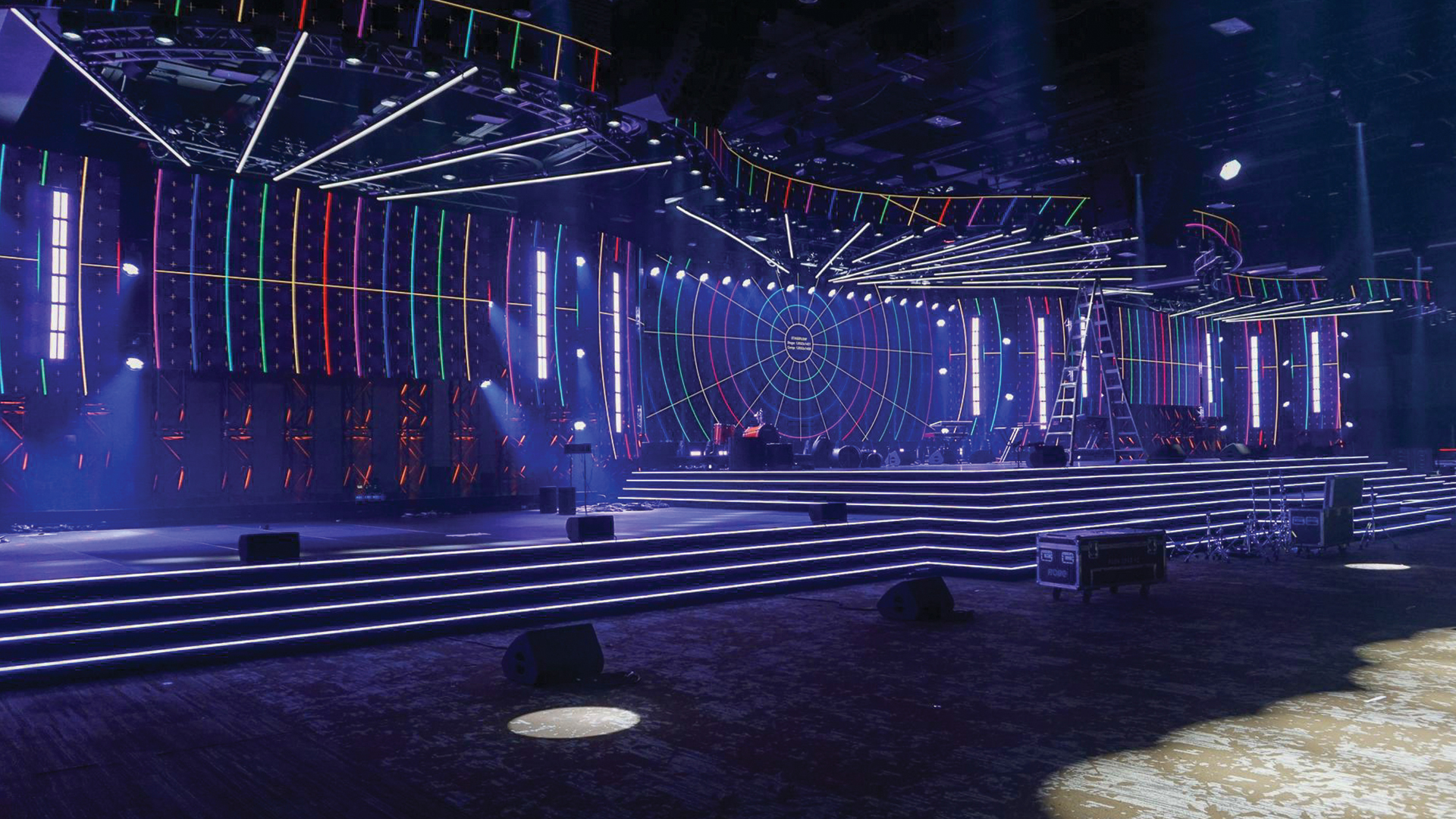
Stage design has undergone a fundamental transformation with the emergence of modular scenic LED set pieces—sculptural video elements that defy traditional rectangular screen constraints. Where productions once chose between flat LED walls or non-illuminated scenic structures, today’s designers merge both into dynamic architectural forms that respond to content in real-time.
Beyond the Rectangle: New Form Factors
The innovation began with curved LED panels from manufacturers like ROE Visual and Unilumin, but true modular scenic work pushes further. Products like the ROE Visual Vanish V8 offer transparent LED configurations that appear almost invisible when powered off, then transform into vivid displays when activated.
The Absen Polaris Series and INFiLED AE Series provide specialized panels designed for irregular shapes—triangular modules, hexagons, and custom profiles that snap together like dimensional puzzles. These products enable scenic designers to create LED totems, floating geometric forms, and sculptural backdrops impossible with conventional panel inventory.
The Technology Behind Flexible LED
Flexible LED represents another breakthrough category. Products like ROE Visual Black Marble and Creative LED FlexMax use bendable substrate materials that conform to curved surfaces. Wrapped around columns, draped across curved set walls, or formed into organic shapes, these panels bring video to surfaces previously considered impossible.
The engineering challenges are significant. Pixel pitch consistency must remain uniform across curved surfaces to prevent visible seams. Power and data distribution require creative routing through non-standard structures. Thermal management becomes complex when panels face multiple directions.
Processing and Mapping Requirements
Irregular LED configurations demand sophisticated media server mapping. Platforms like disguise (d3) and Green Hippo Hippotizer create virtual 3D models of scenic elements, allowing designers to preview content on accurate representations before installation. The NotchLC codec enables real-time rendering of content specifically designed for unusual display geometries.
- UV mapping translates flat content onto 3D surfaces accurately
- Mesh correction compensates for physical irregularities in constructed elements
- Edge blending creates seamless transitions between adjacent panels at angles
- Color calibration ensures consistent appearance across panels from different manufacturing batches
Structural Integration Challenges
Modular LED scenic pieces require close collaboration between scenic fabricators and video technicians. Companies like TAIT, Scenic Technologies, and ShowTex specialize in custom structures that accommodate LED panels while maintaining structural integrity and aesthetic intent.
Weight distribution presents particular challenges. A 12-foot LED totem might weigh 1,500 pounds or more, requiring substantial base structures or overhead support. The James Thomas Engineering SuperTruss and Tyler Truss GT systems provide engineered solutions rated for these demanding applications.
Historical Context: From Jumbotrons to Sculptural Video
The journey toward modular scenic LED began with the 1980 Sony JumboTron installations at sports venues—massive displays built from individually addressable light modules. These early large-format displays established the concept of video as architectural element rather than mere screen.
Concert touring advanced the technology significantly. U2’s PopMart tour (1997) featured a 170-foot wide LED screen arch that demonstrated video could function as scenery. The Nine Inch Nails Lights in the Sky tour (2008) introduced transparent LED curtains that performers could walk through—a concept that directly influenced today’s modular scenic approach.
Content Design Considerations
Content created for modular scenic LED differs fundamentally from standard video production. Designers must consider how imagery interacts with physical form rather than simply filling rectangular frames.
Software like TouchDesigner and Notch enable generative content that responds to music, movement sensors, or data inputs in real-time. Rather than pre-rendered video, these systems create evolving visuals that make each performance unique.
- Particle systems adapt naturally to irregular display shapes
- Gradient animations flow across multiple elements creating unified effects
- Abstract geometric content complements sculptural forms without fighting their shapes
- Data visualization transforms metrics into architectural light expressions
Applications Across Event Types
Corporate Events
Product launches benefit tremendously from modular scenic LED. Apple, Samsung, and automotive manufacturers have embraced sculptural video elements that reveal products through dramatic lighting moments. The physical presence of LED structures creates photo opportunities that flat screens cannot match.
Broadcast and Television
Award shows and talk programs increasingly feature LED scenic elements. The Academy Awards, MTV VMAs, and late-night programs use modular LED to create signature environments that change throughout broadcasts.
Experiential Marketing
Brand activations at trade shows and pop-up experiences use modular LED to create immersive environments. These installations often incorporate interactive elements—touch sensors, motion tracking, or social media integration—that transform passive viewing into active participation.
Budget and Rental Considerations
Modular scenic LED commands premium pricing. Specialized panels cost 2-4 times more than standard rectangular inventory. Custom structural elements add significant fabrication costs. Extended programming time for content mapping increases labor budgets.
Major rental houses including PRG, 4Wall Entertainment, and VER (now owned by PRG) maintain specialized modular LED inventory. The Creative Technology (CT) group focuses particularly on innovative LED configurations for high-end productions.
Future Developments
Emerging technologies point toward even more ambitious modular scenic applications. MicroLED developments from Samsung and others promise higher resolution at smaller form factors. Transparent OLED panels may eventually enable scenic elements that switch between opaque video display and clear window functionality.
The integration of augmented reality with physical LED structures represents another frontier. Virtual extensions of physical scenic elements, visible through AR glasses or smartphone cameras, could expand modular LED designs beyond physical limitations while maintaining tangible anchor points in real space.
For production professionals, mastering modular scenic LED represents essential career development. The technology continues reshaping expectations for what live events can achieve visually, pushing boundaries that seemed fixed just a decade ago into exciting new territory.
