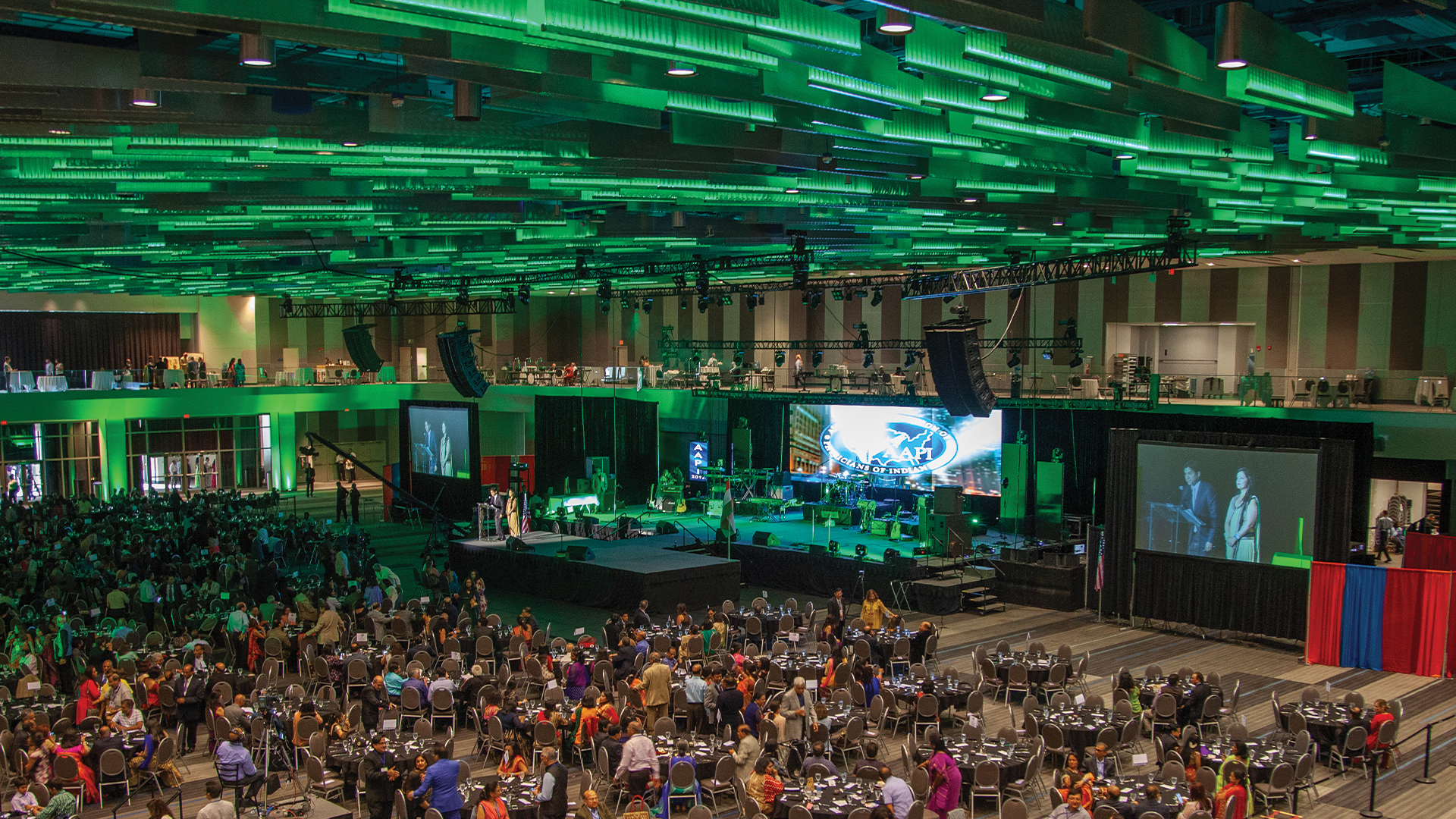
Concert audiences feel line array speakers before seeing them the chest-punching bass, crystal-clear vocals reaching the back row, and even coverage that makes every seat feel premium. These distinctive vertical speaker stacks have become ubiquitous at large events for good reason: their physics enable consistent audio quality across thousands of attendees that traditional point-source speakers simply cannot match. Understanding why line arrays dominate large event audio helps production teams specify appropriate systems and recognize when simpler alternatives suffice.
The Physics of Line Source Behavior
Traditional speakers radiate sound spherically, with volume dropping approximately 6dB for each doubling of distance. An audience member 100 feet from a point source hears the sound 12dB quieter than someone at 25 feet—a dramatic difference requiring either excessive front-row volume or inadequate rear coverage. Line arrays exploit cylindrical wave propagation by arranging multiple drivers vertically, creating a line source that loses only 3dB per distance doubling. This gentler falloff enables more consistent volume from front to back, reducing the dynamic range challenge that large venues present.
Manufacturers like L-Acoustics, d&b audiotechnik, Meyer Sound, and JBL Professional have refined line array design over decades. The L-Acoustics K Series and d&b SL-Series represent current flagship products, with sophisticated waveguide designs that maintain line source behavior across frequency ranges. These systems incorporate variable curvature capability—individual boxes angle relative to each other, enabling coverage patterns tailored to specific venue geometries.
Coverage Prediction and System Design
Acoustic modeling software transforms line array deployment from art to science. L-Acoustics Soundvision, d&b ArrayCalc, and Meyer MAPP 3D predict coverage patterns based on venue geometry, speaker positioning, and array configuration. Designers input room dimensions, seating layouts, and acoustic characteristics; software calculates optimal speaker positions and angles to achieve even coverage. This predictive capability enables pre-production system design that arrives at venues with confidence rather than requiring extensive on-site experimentation.
Subwoofer deployment complements line array high-frequency coverage. Low frequencies propagate omnidirectionally regardless of speaker configuration, requiring separate consideration for bass management. Ground-stacked subwoofer arrays, flown sub configurations, and cardioid sub arrangements each serve different requirements. The d&b SL-SUB and L-Acoustics KS28 exemplify high-performance subwoofers designed to integrate with their respective line array ecosystems.
Practical Deployment Considerations
Line arrays require substantial rigging infrastructure that smaller systems avoid. A main array might weigh 2,000kg or more, demanding multiple rigging points rated for concentrated loads. Chain motor systems from CM Lodestar or Columbus McKinnon raise and position arrays, with precise angle adjustment during focus. This infrastructure adds cost and complexity appropriate for large events but excessive for smaller gatherings where simpler systems suffice.
System processing and amplification must match array capabilities. LA Network from L-Acoustics, d&b ArrayProcessing, and equivalent technologies optimize array performance through sophisticated DSP that accounts for speaker interaction, room acoustics, and desired coverage characteristics. These processing systems represent significant investment beyond speaker hardware but deliver the performance that makes premium line arrays worthwhile. Events that rent line array speakers without appropriate processing sacrifice much of their potential.
Line arrays deliver audio quality for large audiences that alternative approaches cannot match efficiently. Their physics, engineering, and ecosystem integration represent decades of refinement aimed at the specific challenge of covering thousands of listeners consistently. Productions serving large venues benefit from understanding what line arrays offer and why their complexity serves a purpose—information that guides appropriate specification and realistic expectations for what professional audio systems can achieve.
