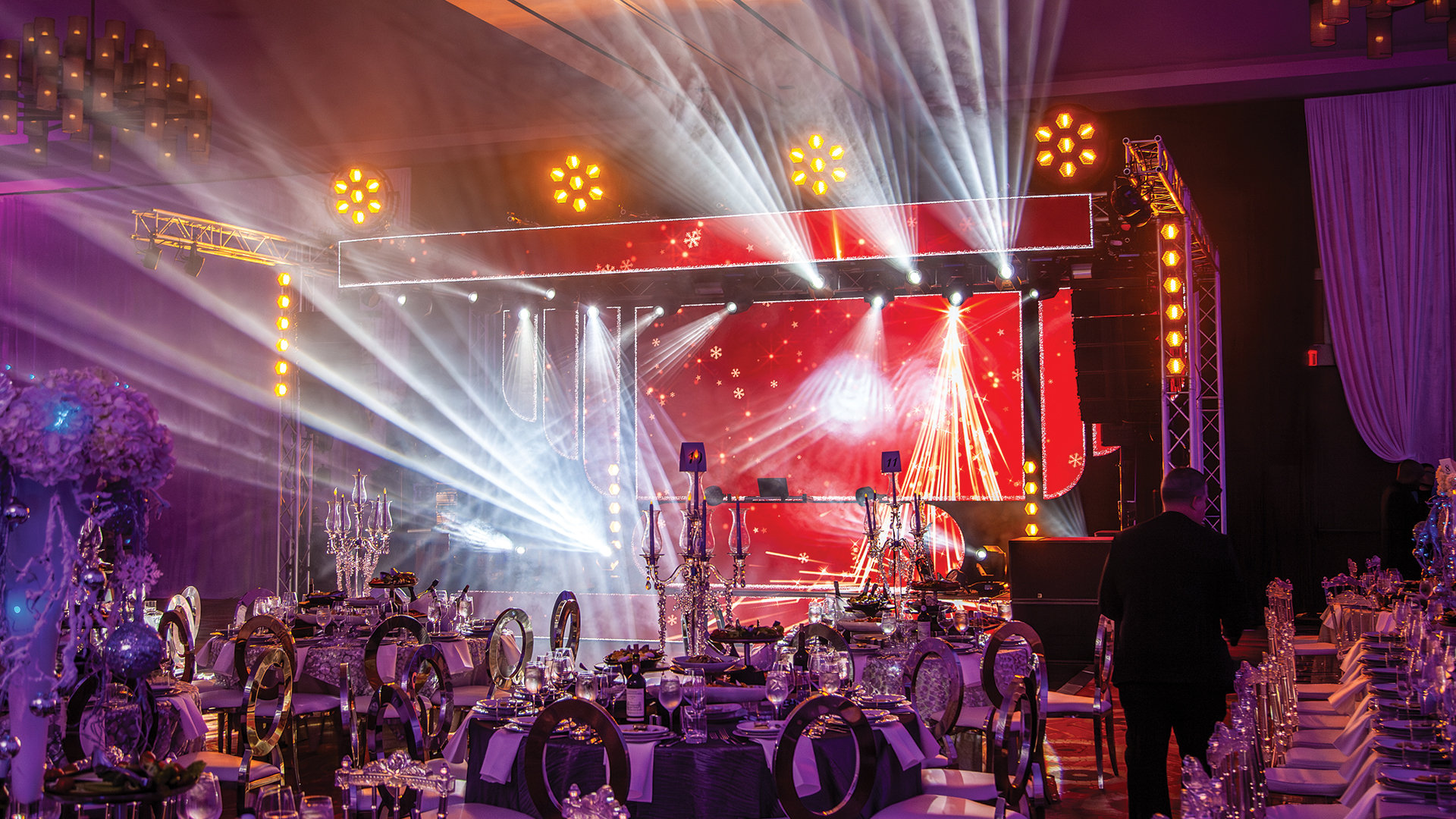
The brand reveal featured a twelve-foot company logo constructed entirely from LED modules—not a flat screen displaying the logo, but an actual three-dimensional sculptural form with LED surfaces wrapping around curves, edges, and dimensional features. As the reveal moment arrived, the logo transformed through animated sequences: brand colors flowing across surfaces, product imagery appearing in unexpected places, the entire sculpture pulsing with music as presenters spoke about company vision. This fusion of scenic design and digital display represents the contemporary frontier of stage design, where traditional scenic fabrication techniques combine with LED technology to create elements that couldn’t exist through either discipline alone.
Understanding Flexible and Creative LED Formats
Traditional LED panels optimize for flat wall configurations, but creative LED formats enable scenic applications impossible with rigid rectangles. ROE Visual Strip products provide LED in narrow linear formats that curve around scenic elements. Flexible LED mesh from manufacturers like PixelFLEX and Leyard conforms to curved surfaces that rigid panels cannot address. Transparent LED films from Glux and others apply to glass and acrylic surfaces, transforming existing architectural elements into display surfaces. Each format enables different scenic applications, and understanding their characteristics guides appropriate selection.
Pixel pitch requirements for scenic LED depend heavily on viewing distance and application. A sculptural element viewed from thirty feet doesn’t require the tight pixel pitch that close-up video display demands. This flexibility enables cost optimization—larger pitch products cost less while providing adequate resolution for many scenic applications. The ROE Visual Magic Cube and similar modular LED products provide building blocks for three-dimensional scenic constructions without requiring custom fabrication for every application.
Integration with Physical Scenic Construction
Successful scenic LED requires collaboration between scenic fabricators and video engineers. Physical structures must accommodate LED mounting, cable routing, power distribution, and heat dissipation that digital elements require. Companies like Atomic Design, ShowMotion, and TAIT specialize in this integration, developing fabrication approaches that serve both structural and technical requirements. Early coordination during design phases prevents the conflicts that arise when scenic and video teams work independently until installation reveals incompatibilities.
Structural support for scenic LED must address both static loads and the access requirements that service demands. LED components fail occasionally; designs that bury modules deep within structures without access panels create maintenance nightmares when pixels die mid-event. Ventilation pathways prevent the heat accumulation that degrades LED performance and lifespan. Cable management provisions route power and data without visible runs that compromise scenic aesthetics. The best scenic LED designs appear effortless while incorporating thoughtful engineering that addresses these practical requirements.
Content Mapping for Complex Geometries
Displaying content on non-rectangular LED configurations requires content mapping that translates flat video into the actual physical geometry. Media servers like disguise, Notch, and TouchDesigner provide mapping tools that model physical geometries and calculate appropriate pixel assignments. A curved logo surface receives content warped to appear correct from intended viewing angles. Multiple LED elements forming a larger scenic piece receive coordinated content that maintains visual continuity across separate physical components.
Creating 3D models of scenic LED elements enables accurate pre-visualization before fabrication. Designers can evaluate how content will appear on complex surfaces, identifying potential problems before construction commits resources. Software workflows from concept through visualization to production output streamline the development process. The disguise Designer software provides tools specifically for this workflow, enabling content creators to work with accurate representations of physical scenic geometries throughout the design process.
Historical Context: LED in Scenic Design
The integration of LED into scenic design evolved through several phases. Early concert touring in the 1990s positioned LED screens as flat surfaces within scenic frameworks—technology visible but architecturally separate from physical design elements. U2‘s innovative stage designs pushed boundaries, with the 360° tour’s claw structure integrating LED in ways that blurred the line between screen and sculpture. Broadway productions like Spider-Man: Turn Off the Dark and Dear Evan Hansen demonstrated how LED could serve dramatic rather than merely technical purposes.
Corporate events adopted these techniques as LED costs decreased and creative capabilities expanded. Award shows pioneered elaborate scenic LED treatments that product launches and corporate galas subsequently adapted. The development of flexible LED formats removed geometric constraints that previously limited scenic applications. Contemporary productions routinely integrate LED in ways that first-generation designers couldn’t have imagined—technology and scenery merged rather than merely adjacent.
Practical Design Considerations
Brightness matching presents challenges when scenic LED elements operate alongside conventional screens. Different LED products from different manufacturers exhibit different brightness and color characteristics. A scenic logo element that appears significantly brighter or differently colored than adjacent presentation screens creates visual discord. Calibration using tools like Brompton Tessera processing helps match disparate LED products, though fundamental differences in LED technology sometimes resist perfect harmonization.
Viewing angle considerations differ for scenic elements positioned at various angles to audiences. An LED element mounted overhead may require different panel selection than one at audience eye level. Products optimized for direct viewing may exhibit significant brightness falloff when viewed obliquely. Designers must consider the actual viewing geometry their scenic elements will experience, selecting LED formats with appropriate viewing angle specifications. Prototyping with actual products at actual angles prevents surprises during installation when viewing characteristics prove unsuitable for intended applications.
Budget and Timeline Realities
Custom scenic LED elements cost substantially more than equivalent square footage of conventional LED wall. The fabrication of physical structures, the integration of LED components with scenic materials, the content mapping complexity, and the engineering required for unusual geometries all add costs that simple screens avoid. Budget planning must account for these realities, with preliminary estimates typically running 3-5x conventional LED costs for equivalent display area in custom scenic applications. The creative impact may justify this premium, but stakeholders must understand the investment required.
Timeline requirements extend similarly. Custom fabrication requires design development, engineering review, construction time, and testing before scenic elements ship. Content creation for complex geometries takes longer than flat-screen content development. Installation of integrated scenic/LED elements requires coordination between trade specialties that simple LED wall deployment doesn’t involve. Planning should budget eight to twelve weeks minimum for significant custom scenic LED development—longer for highly complex or novel applications. Compressing these timelines risks quality compromises or outright failures when inadequate development produces problematic results.
Scenic LED elements represent the cutting edge of stage design possibility—transforming passive physical structures into dynamic visual surfaces that change throughout events. The combination of fabrication craft and video technology enables experiences that neither discipline achieves independently. Productions that invest the creativity, coordination, and budget required create memorable environments that distinguish their events from conventional approaches. As LED technology continues advancing—becoming lighter, more flexible, higher resolution—the possibilities for scenic integration expand correspondingly, promising future applications that today’s designers can only imagine.
